
Svabovce Deposit
Five sub-deposits covering 30.52 km² southeast of Poprad in Slovakia's Prešov Region — 13.9 Mt historic manganese resource at 14.47% Mn grade, with 35 km of documented underground workings.
Svabovce Manganese Deposit
Five sub-deposits covering 30.52 km² southeast of Poprad — one of Europe's richest historic manganese resource records, with 35 km of documented underground workings.
The Svabovce deposit is located southeast of the city of Poprad in the Prešov Region of eastern Slovakia. It comprises five sub-deposits — Hôrka-Levočské pohorie, Švábovce, Kišovce, Primovce, and Levočské pohorie — all within a single 30.52 km² exploration licence.
The deposit hosts carbonate-hosted manganese mineralisation dominated by Rhodochrosite (manganese carbonate), with Pyrolusite (manganese dioxide) and Manganite (manganese oxide-hydroxide) also present. The mineralisation occurs as stratiform lenses and seams within a Paleogene flysch sedimentary sequence, with consistent lateral continuity across all five sub-deposits.
The combined historic resource across all five sub-deposits totals approximately 13.9 Mt at an average grade of 14.47% Mn, based on GKZ classification by the Slovak State Geological Institute (ŠGÚDŠ). The deposit has an average depth of approximately 100 m (maximum 250 m), with two distinct mineralised levels: an upper horizon at 40–80 m and a lower horizon at 80–130 m depth.
Existing 35 km of underground workings, accessible via 7+ adits, provides a significant head start for future development — eliminating substantial early-stage mine access capital that would be required at a greenfield site.
- Location
- Southeast of Poprad, Prešov Region, eastern Slovakia
- Sub-Deposits
- Hôrka-Levočské pohorie, Švábovce, Kišovce, Primovce, Levočské pohorie
- Ore Minerals
- Rhodochrosite (MnCO₃), Pyrolusite (MnO₂), Manganite (MnOOH)
- Depth Profile
- Average ~100 m; maximum 250 m. Upper horizon 40–80 m; lower horizon 80–130 m.
- Mining History
- Open-cut mining 1850s–1907; underground operations to 1971; 35 km of passages, 7+ adits
Sub-Deposit Resource Table
Five sub-deposits with GKZ-classified resources across three confidence categories.
| Sub-Deposit | Z-1 (t) | Z-2 (t) | Z-3 (t) | Sub-Total (t) |
|---|---|---|---|---|
| Hôrka-Levočské pohorie | 474,362 | 9,482,083 | — | 9,956,445 |
| Švábovce | 267,642 | 186,997 | 987,066 | 1,441,705 |
| Kišovce | 296,271 | 197,759 | 111,240 | 605,270 |
| Primovce | 120,667 | 235,904 | 209,634 | 566,205 |
| Levočské pohorie | 28,375 | 457,433 | 804,535 | 1,290,343 |
| TOTAL (within licence) | — | 11,611,568 | ||
*GKZ classification: Z-1 (Measured equivalent), Z-2 (Probable equivalent), Z-3 (Inferred equivalent). NOT NI 43-101 compliant. Additional historic tonnage outside current licence boundary brings total to ~13.9 Mt.
Geological Setting & Mining History
Geological Setting
- Ore Type
- Carbonate-hosted — Rhodochrosite (Mn carbonate), Pyrolusite (Mn dioxide), Manganite (Mn oxide-hydroxide). Paleogene sedimentary sequence.
- Mineralisation Style
- Stratiform lenses and seams within Paleogene flysch sediments — consistent lateral continuity across all five sub-deposits.
- Two Mineralised Levels
- Upper horizon at 40–80 m depth; lower horizon at 80–130 m depth. Average depth ~100 m; maximum 250 m.
Mining History
- Open-Cut Period
- 1850s to 1907 — Early surface mining extracting manganese from exposed outcrops and shallow pits.
- Underground Mining
- Operations continued until 1971, establishing 35 km of documented underground passages with 7+ accessible adits and shafts.
- Current Status
- Existing underground workings remain partly accessible — providing significant infrastructure for future development.
Svabovce Licence & Sub-Deposit Map
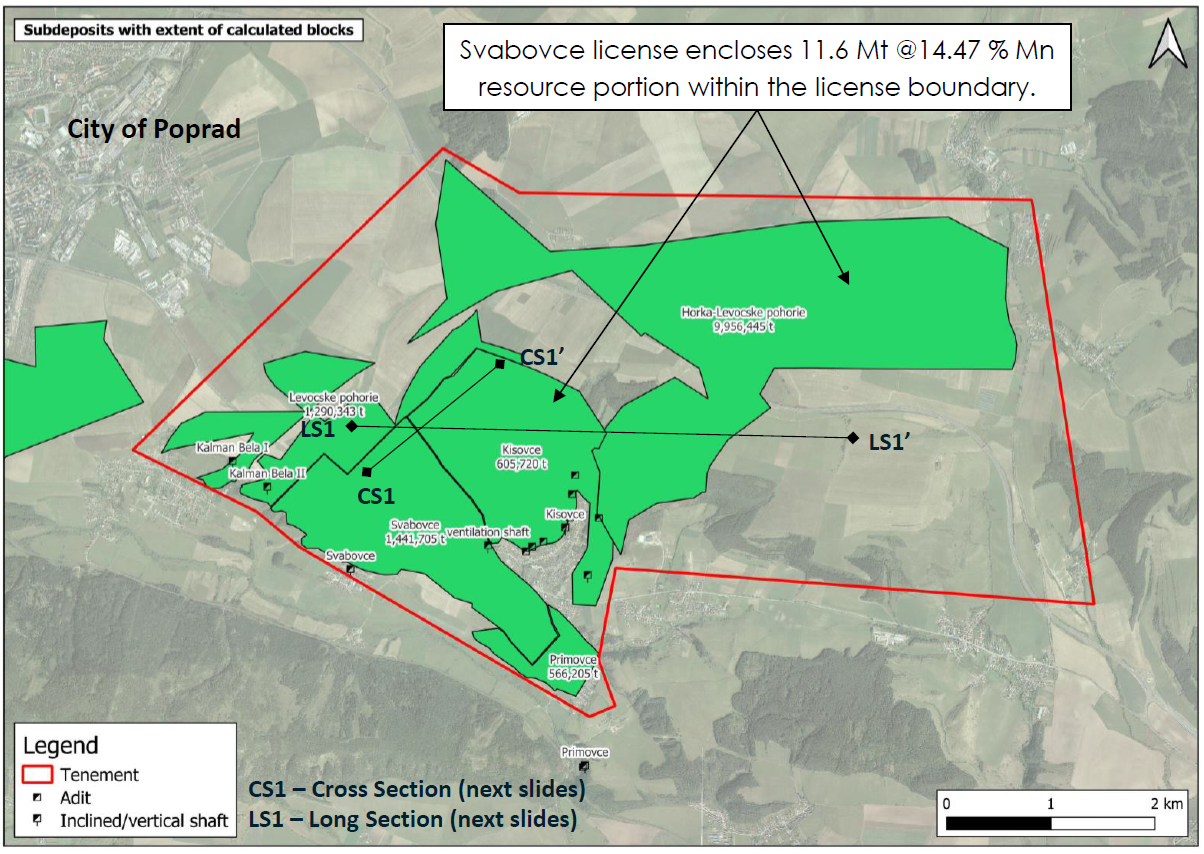
Svabovce exploration licence area (30.52 km²) with five sub-deposit boundaries. GKZ-classified resources are shown by sub-deposit. Not NI 43-101 compliant.
Exploration Upside
Multiple vectors for resource expansion beyond the current historic estimate.
Northern Extension
Manganese-bearing sediments have been drilled 40 km north of the current deposit area, indicating the mineralised horizon extends well beyond the current licence boundary.
Untested Areas
Significant areas to the north, northeast, and east of the known deposits remain untested by drilling — representing high-priority exploration targets.
Cut-Off Grade Upside
Historic Soviet-era cut-offs were set at 15–20% Mn, leaving significant tonnage below cut-off that modern battery-grade processing methods could potentially exploit economically.
Carbonate Ore vs. Oxide Ore
Both Slovakia deposits are carbonate-hosted — providing a structural cost advantage over conventional oxide ore manganese producers worldwide.
| Parameter | Carbonate Ore (Union Power Metals) | Oxide Ore (Conventional) |
|---|---|---|
| Processing Route | Direct acid leaching | Calcination / roasting required |
| Energy Consumption | 70–80% lower | 800–1,000°C roasting required |
| Reductants Required | None | Yes |
| CO₂ Footprint | Significantly lower | Higher (combustion for roasting) |
| Impurities in Final Product | Fewer deleterious impurities | More impurities |
Explore Further
Learn about the EU policy driving domestic manganese demand, or explore how to participate in Union Power Metals's growth story.