
Lagerstätte Svabovce
Fünf Teillagerstätten über 30,52 km² südöstlich von Poprad in der ostslowakischen Region Prešov — 13,9 Mt historische Manganressource bei 14,47 % Mn-Gehalt, mit 35 km dokumentierter untertägiger Auffahrungen.
Manganlagerstätte Svabovce
Fünf Teillagerstätten über 30,52 km² südöstlich von Poprad — eine der reichsten historischen Manganressourcenaufzeichnungen Europas, mit 35 km dokumentierter untertägiger Auffahrungen.
Die Lagerstätte Svabovce liegt südöstlich der Stadt Poprad in der Region Prešov in der östlichen Slowakei. Sie umfasst fünf Teillagerstätten — Hôrka-Levočské pohorie, Švábovce, Kišovce, Primovce und Levočské pohorie — alle innerhalb einer einzigen 30,52 km² großen Explorationslizenz.
Die Lagerstätte enthält karbonatgebundene Manganmineralisation, die hauptsächlich aus Rhodochrosit (Mangankarbonat) besteht, daneben treten auch Pyrolusit (Mangandioxid) und Manganit (Manganoxid-Hydroxid) auf. Die Mineralisation tritt als stratiforme Linsen und Schichten innerhalb einer paläogenen Flysch-Sedimentabfolge auf, mit konsistenter lateraler Kontinuität über alle fünf Teillagerstätten hinweg.
Die kombinierte historische Ressource über alle fünf Teillagerstätten beläuft sich auf etwa 13,9 Mt bei einem durchschnittlichen Gehalt von 14,47 % Mn, basierend auf der GKZ-Klassifikation des Slowakischen Staatlichen Geologischen Instituts (ŠGÚDŠ). Die Lagerstätte hat eine durchschnittliche Tiefe von etwa 100 m (maximal 250 m), mit zwei verschiedenen mineralisierten Niveaus: einem oberen Horizont in 40–80 m Tiefe und einem unteren Horizont in 80–130 m Tiefe.
Die bestehenden 35 km untertägiger Auffahrungen, zugänglich über mindestens 7 Stollen, bieten einen erheblichen Startvorteil für die zukünftige Entwicklung — sie eliminieren das beträchtliche Frühphasen-Kapital für Minenzugang, das an einem Greenfield-Standort erforderlich wäre.
- Lage
- Südöstlich von Poprad, Region Prešov, östliche Slowakei
- Teillagerstätten
- Hôrka-Levočské pohorie, Švábovce, Kišovce, Primovce, Levočské pohorie
- Erzminerale
- Rhodochrosit (MnCO₃), Pyrolusit (MnO₂), Manganit (MnOOH)
- Tiefenprofil
- Durchschnittlich ~100 m; maximal 250 m. Oberer Horizont 40–80 m; unterer Horizont 80–130 m.
- Bergbaugeschichte
- Tagebau 1850er–1907; Untertagebau bis 1971; 35 km Auffahrungen, mindestens 7 Stollen
Ressourcen-Tabelle der Teillagerstätten
Fünf Teillagerstätten mit GKZ-klassifizierten Ressourcen über drei Vertrauenskategorien.
| Teillagerstätte | Z-1 (t) | Z-2 (t) | Z-3 (t) | Zwischensumme (t) |
|---|---|---|---|---|
| Hôrka-Levočské pohorie | 474.362 | 9.482.083 | — | 9.956.445 |
| Švábovce | 267.642 | 186.997 | 987.066 | 1.441.705 |
| Kišovce | 296.271 | 197.759 | 111.240 | 605.270 |
| Primovce | 120.667 | 235.904 | 209.634 | 566.205 |
| Levočské pohorie | 28.375 | 457.433 | 804.535 | 1.290.343 |
| GESAMT (innerhalb der Lizenz) | — | 11.611.568 | ||
*GKZ-Klassifikation: Z-1 (Measured-Äquivalent), Z-2 (Probable-Äquivalent), Z-3 (Inferred-Äquivalent). NICHT NI-43-101-konform. Zusätzliche historische Tonnage außerhalb der aktuellen Lizenzgrenze bringt die Gesamtmenge auf ~13,9 Mt.
Geologisches Umfeld & Bergbaugeschichte
Geologisches Umfeld
- Erztyp
- Karbonatgebunden — Rhodochrosit (Mn-Karbonat), Pyrolusit (Mn-Dioxid), Manganit (Mn-Oxid-Hydroxid). Paläogene Sedimentabfolge.
- Mineralisationstyp
- Stratiforme Linsen und Schichten innerhalb paläogener Flysch-Sedimente — konsistente laterale Kontinuität über alle fünf Teillagerstätten hinweg.
- Zwei mineralisierte Niveaus
- Oberer Horizont in 40–80 m Tiefe; unterer Horizont in 80–130 m Tiefe. Durchschnittliche Tiefe ~100 m; maximal 250 m.
Bergbaugeschichte
- Tagebauphase
- 1850er Jahre bis 1907 — Früher Tagebau, bei dem Mangan aus freiliegenden Ausbissen und flachen Gruben gewonnen wurde.
- Untertagebau
- Der Betrieb wurde bis 1971 fortgeführt; dabei entstanden 35 km dokumentierter untertägiger Auffahrungen mit mindestens 7 zugänglichen Stollen und Schächten.
- Aktueller Status
- Die bestehenden untertägigen Auffahrungen sind weiterhin teilweise zugänglich — und bieten eine bedeutende Infrastruktur für die zukünftige Entwicklung.
Karte der Svabovce-Lizenz & Teillagerstätten
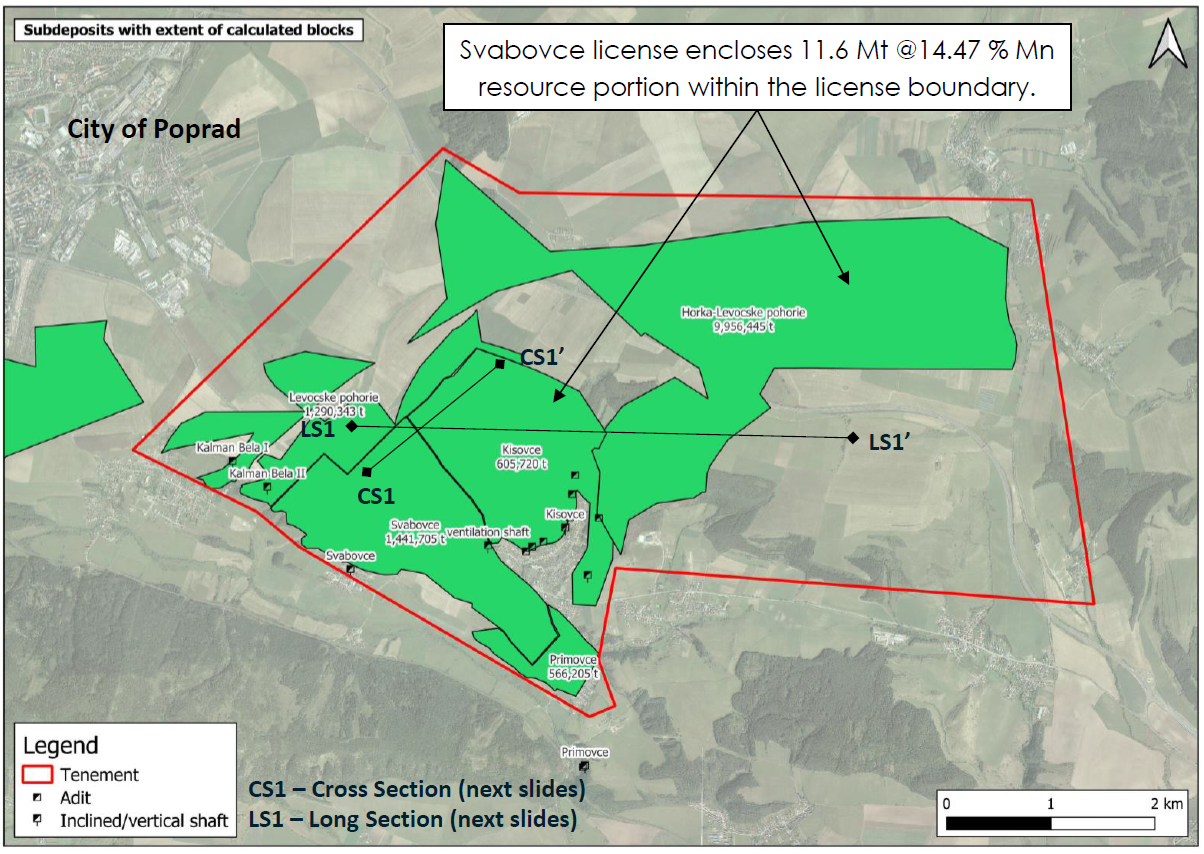
Gebiet der Explorationslizenz Svabovce (30,52 km²) mit den Grenzen der fünf Teillagerstätten. GKZ-klassifizierte Ressourcen sind nach Teillagerstätte dargestellt. Nicht NI-43-101-konform.
Explorationspotenzial
Mehrere Ansatzpunkte für eine Ressourcenerweiterung über die aktuelle historische Schätzung hinaus.
Nördliche Erweiterung
Manganführende Sedimente wurden 40 km nördlich des aktuellen Lagerstättengebiets erbohrt, was darauf hindeutet, dass sich der mineralisierte Horizont weit über die aktuelle Lizenzgrenze hinaus erstreckt.
Ungetestete Gebiete
Bedeutende Gebiete nördlich, nordöstlich und östlich der bekannten Lagerstätten sind bislang nicht durch Bohrungen getestet — sie stellen Explorationsziele mit hoher Priorität dar.
Potenzial beim Cut-off-Gehalt
Die historischen Cut-off-Gehalte aus der Sowjetära wurden bei 15–20 % Mn angesetzt, wodurch erhebliche Tonnage unterhalb des Cut-off-Gehalts verbleibt, die moderne Verarbeitungsmethoden für Batteriequalität potenziell wirtschaftlich nutzen könnten.
Karbonaterz vs. Oxiderz
Beide slowakischen Lagerstätten sind karbonatgebunden — das bietet einen strukturellen Kostenvorteil gegenüber konventionellen Oxiderz-Manganproduzenten weltweit.
| Parameter | Karbonaterz (Union Power Metals) | Oxiderz (konventionell) |
|---|---|---|
| Verarbeitungsroute | Direkte Säurelaugung | Kalzinierung / Röstung erforderlich |
| Energieverbrauch | 70–80 % geringer | Röstung bei 800–1.000 °C erforderlich |
| Reduktionsmittel erforderlich | Keine | Ja |
| CO₂-Fußabdruck | Deutlich geringer | Höher (Verbrennung für die Röstung) |
| Verunreinigungen im Endprodukt | Weniger schädliche Verunreinigungen | Mehr Verunreinigungen |
Mehr entdecken
Erfahren Sie mehr über die EU-Politik, die die heimische Mangannachfrage antreibt, oder erkunden Sie, wie Sie an der Wachstumsgeschichte von Union Power Metals teilhaben können.