
Vancouver, British Columbia — November 17, 2026 — Union Power Metals Corporation (“Union Power” or the “Company”) (CSE: UPPR, OTCQB: UPERF, FRA: UPR) is pleased to report that the first modern drill holes at its Michalová manganese project in central Slovakia have confirmed the manganese mineralization recorded by historical drilling in the 1950s. Twin holes V-13 and V-11 both intersected near-surface manganese oxide mineralization at the depths and at thicknesses comparable to those recorded in the historical logs. The results are the first direct test of the archival dataset on which the Michalová project is built and are an encouraging first step in assessing its reliability.
Highlights
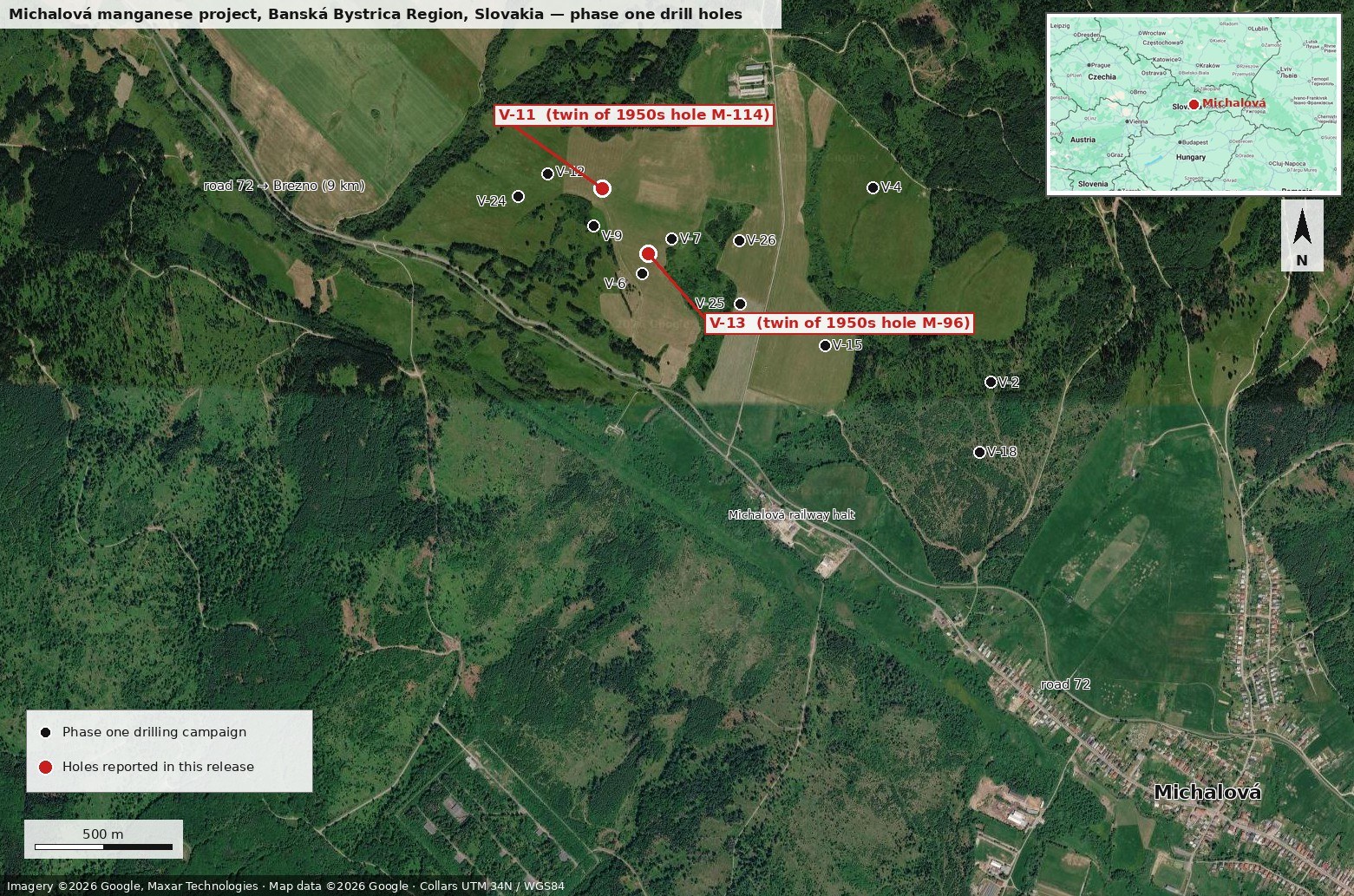
- Historical mineralization corroborated. Both twin holes intersected manganese oxide mineralization within one metre of the depth recorded in the 1950s logs, at comparable thickness. V-13 was collared at the recorded location of historical hole M-96; V-11 was collared approximately 8 metres from the recorded location of historical hole M-114.
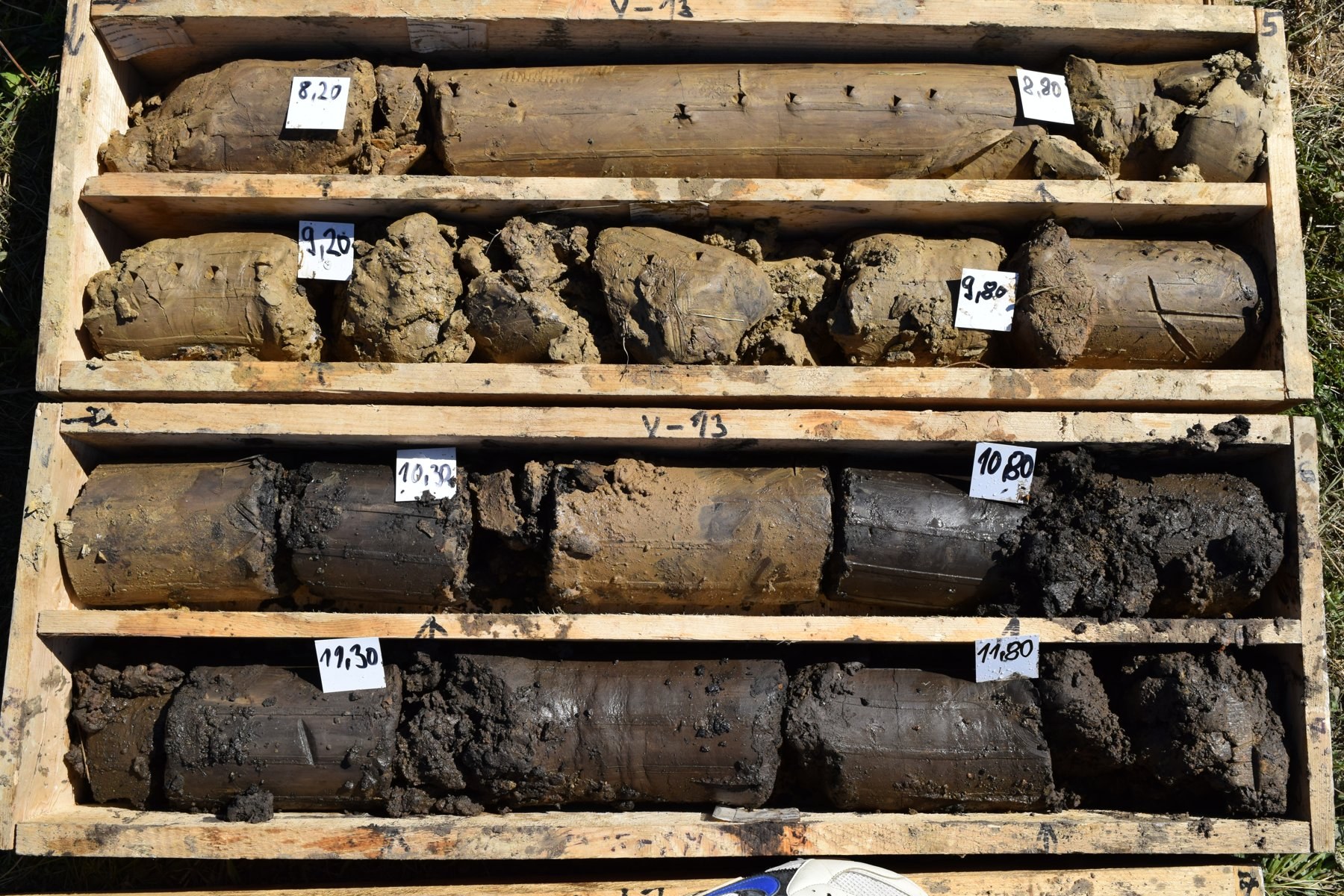
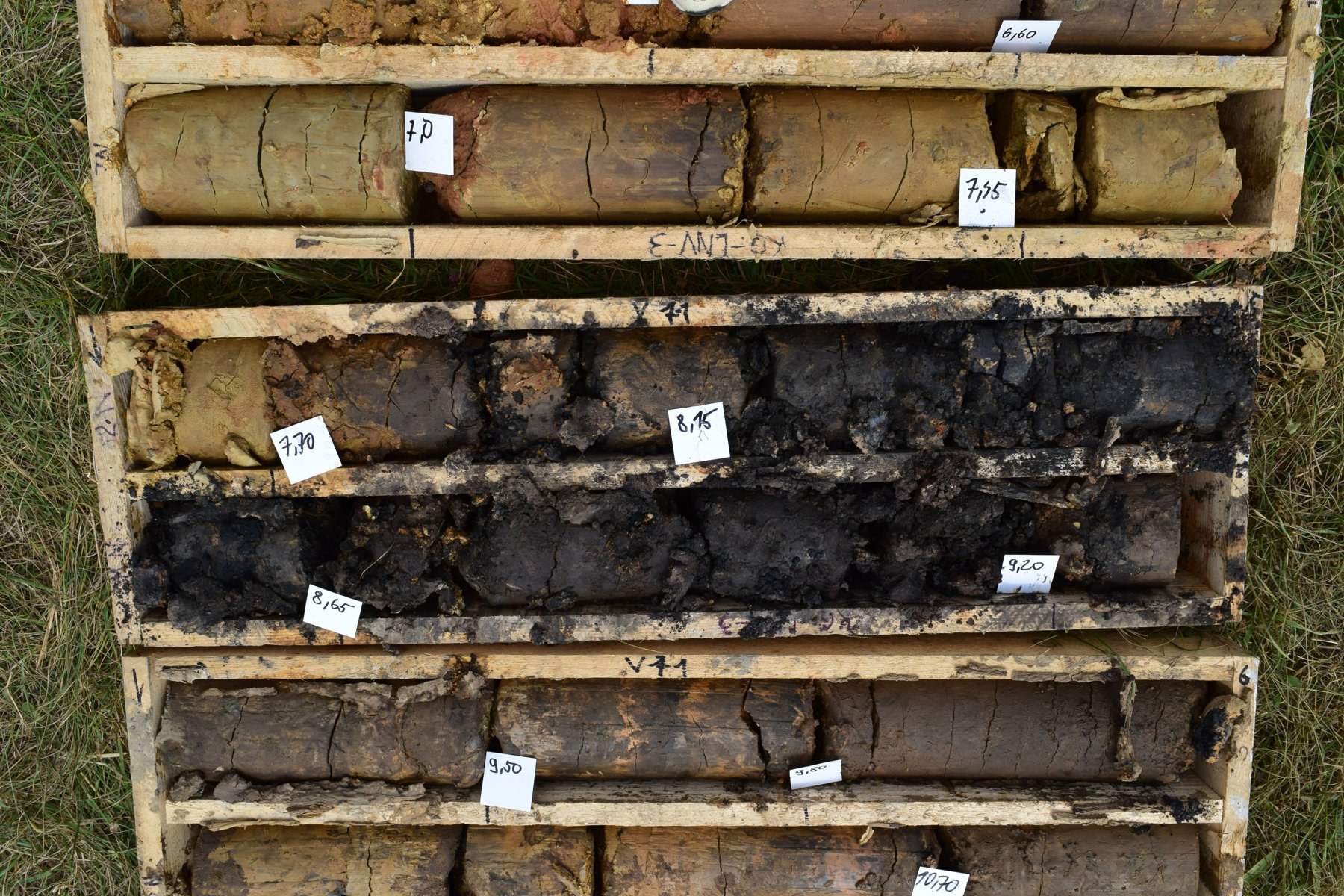
- Strong near-surface mineralization. V-13 intersected 3.4 metres of black manganese oxide mineralization from 10.0 metres, with a further 0.9-metre layer from 6.5 metres. V-11 intersected 2.2 metres from 7.7 metres. Core recovery through the mineralized intervals was 100%.
- Historical data verification. The Michalová archive contains approximately 290 historical drill holes and nearly 500 assayed intervals. Twin-hole drilling is the established method to test whether historical data of this kind can be relied upon, and these first two holes are an encouraging start. Further twin holes and laboratory assays are required before conclusions can be drawn about the dataset as a whole.
- Fresh material for metallurgical testwork. Core from the completed holes has been sampled and delivered to ALS for analysis, and representative oxide and carbonate composites are being assembled for metallurgical testwork aimed at battery-grade manganese products.
- Laboratory assays are pending. Results from the remaining completed holes will be reported as they are compiled, and laboratory assay results as they are received.
Program Objectives
The Michalová drill program has two objectives. The first is to verify the historical exploration data by drilling twin holes at or adjacent to selected 1950s drill holes and comparing the depth, thickness and character of the mineralization, and, once laboratory assays are received, the grade, with the historical records. The second is to obtain fresh, representative material from the oxide and carbonate mineralization for metallurgical testwork designed to evaluate Michalová’s potential to produce high-purity, battery-grade manganese products.
The results reported here address the first objective. The comparison with historical drilling at this stage is a comparison of the depth, thickness and character of the mineralized horizon as logged in the core; the comparison of grades will follow once laboratory assays are received. Core from the completed holes has been sampled and delivered to ALS, representative composites for metallurgical testwork are being assembled, and drilling of the remaining holes of the 25-hole program is planned to continue.
Hole V-13 (twin of historical hole M-96)
V-13 was collared at the recorded location of historical hole M-96, as digitised from the 1950s archival plans, and drilled vertically to a depth of 25.9 metres. The hole intersected 0.7 metres of soil and deluvial loam, followed by deluvial stony loam with scattered manganese-bearing detrital fragments to 4.3 metres, and then plastic clays of the Paleogene sequence that host the manganese mineralization.
Two layers of manganese mineralization were logged. The upper layer, from 6.5 to 7.4 metres, consists of secondary manganese ore between layers of plastic clay, with manganese-rich layers of 19, 23, 1 and 1 centimetres. The main layer, from 10.0 to 13.4 metres, consists of black secondary manganese ore interbedded with thin marly clay partings of up to 3 centimetres, locally with hard manganese ore fragments; manganese ore is the predominant component between 10.0 and 12.4 metres, passing into a regular alternation of manganese ore and brown marly clay between 12.4 and 13.4 metres. Manganese laminae continue to 13.8 metres, below which the hole passed into grey marly clay and claystone with no further mineralization to the end of the hole.
Historical hole M-96 (total depth 18 metres) was sampled from 10.5 to 15.0 metres in the 1950s, returning a weighted average of 4.5 metres at 9.0% Mn, including 1.0 metre at 12.7% Mn. The top of the main mineralized layer in V-13 (10.0 metres) lies within 0.5 metres of the top of the historical sampled interval (10.5 metres). The upper ore layer at 6.5 to 7.4 metres in V-13 has no assayed equivalent in M-96, although the historical log records manganese shows between 9.0 and 10.5 metres.
Hole V-11 (twin of historical hole M-114)
V-11 was collared approximately 8 metres from the recorded location of historical hole M-114 and drilled vertically to a depth of 25.7 metres. Below deluvial loam, the hole intersected plastic clays with laminae of secondary manganese ore from 5.55 metres, passing into the main mineralized interval from 7.7 to 9.9 metres (2.2 metres). The upper and richest part of this interval, from 7.7 to 9.2 metres, consists of light-brown plastic clay with black, sandy layers of secondary manganese ore in laminae of up to 1 centimetre and mineralized fragments of up to 3 centimetres, with ore-bearing sub-intervals at 7.8 to 8.0, 8.15 to 8.45, 8.55 to 8.65 and 8.9 to 9.2 metres. The lower part, from 9.2 to 9.9 metres, consists of plastic clay with secondary manganese ore in sandy layers and in laminae of up to 1 millimetre. Below the main interval, manganese laminae and lenses of up to 3 centimetres continue to 11.3 metres. The remainder of the hole consists of plastic clay with rusty-brown staining and no further mineralization.
Historical hole M-114 (total depth 16 metres) was sampled from 8.6 to 11.4 metres, returning a weighted average of 2.8 metres at 11.2% Mn, including 0.4 metres at 18.3% Mn and 1.0 metre at 14.2% Mn. The mineralized interval in V-11 (7.7 to 9.9 metres) begins 0.9 metres shallower than the historical sampled interval and is of comparable thickness; some variation is expected given the 8-metre offset between the two collars.
“The most important question for Michalová has always been whether the historical data could be trusted,” said Derrick Dao, Chief Executive Officer of Union Power Metals. “The first two twin holes have delivered the encouraging results we were hoping for, providing initial confidence in the reliability of the historical data. They found the manganese where the 1950s geologists recorded it, at a comparable thickness: V-13 was drilled at the recorded location of M-96 and intersected 3.4 metres of black manganese oxide beginning within half a metre of the historical intercept. The Michalová archive holds close to 300 drill holes, and every twin hole that correlates with its historical counterpart is a step toward being able to rely on that dataset. The laboratory assays will tell the grade story, and we will publish them as they arrive.”
— Derrick Dao, Chief Executive Officer, Union Power Metals
| Hole | From (m) | To (m) | Interval (m) | Logged description (ENVIGEO) | Mn minerals, visual estimate |
|---|---|---|---|---|---|
| V-13 | 6.5 | 7.4 | 0.9 | Secondary Mn ore between layers of plastic clay (Mn-rich layers 19 + 23 + 1 + 1 cm) | 80% |
| V-13 | 10.0 | 12.4 | 2.4 | Black secondary Mn ore interbedded with marly clay partings ≤3 cm; locally hard ore fragments; Mn ore predominant | 80% |
| V-13 | 12.4 | 13.4 | 1.0 | Regular alternation of secondary Mn ore and brown marly clay; Mn-rich layers ≤3 cm | 50% |
| V-13 | 13.4 | 13.8 | 0.4 | Marly clay with sandy interbeds and secondary Mn ore laminae ≤0.5 mm | 10% |
| V-11 | 7.7 | 9.2 | 1.5 | Secondary Mn ore-bearing interval; black sandy ore layers in laminae ≤1 cm, fragments ≤3 cm; ore-bearing sub-intervals 7.8–8.0, 8.15–8.45, 8.55–8.65, 8.9–9.2 m | 50% |
| V-11 | 9.2 | 9.9 | 0.7 | Plastic clay; secondary Mn ore in sandy layers (9.65–9.70 m) and laminae ≤1 mm | 25% |
| V-11 | 9.9 | 11.3 | 1.4 | Plastic clay with Mn ore laminae and lenses ≤3 cm; clay predominant | 10–15% |
Intervals are drilled thicknesses in vertical holes; true thickness is not yet known. Visual estimates of manganese mineral content are the logging geologist’s estimates and are not assays; no grade should be inferred from them. Core recovery through all intervals listed was 100%.
| Historical hole | From (m) | To (m) | Interval (m) | Mn (%) | SiO₂ (%) | Fe (%) | Relationship to 2026 hole |
|---|---|---|---|---|---|---|---|
| M-96 | 3.15 | 3.65 | 0.50 | 1.63 | 56.28 | 7.01 | Twinned by V-13 (collared at the recorded M-96 collar location) |
| M-96 | 3.65 | 4.00 | 0.35 | 1.21 | 52.95 | 7.27 | |
| M-96 | 10.50 | 11.00 | 0.50 | 9.49 | 44.58 | 6.98 | |
| M-96 | 11.00 | 12.00 | 1.00 | 11.99 | 43.98 | 5.73 | |
| M-96 | 12.00 | 13.00 | 1.00 | 12.69 | 43.42 | 7.85 | |
| M-96 | 13.00 | 14.00 | 1.00 | 7.83 | 47.85 | 5.24 | |
| M-96 | 14.00 | 15.00 | 1.00 | 3.31 | 46.43 | 5.24 | |
| M-96 composite | 10.50 | 15.00 | 4.50 | 9.0 | Length-weighted average | ||
| M-114 | 8.60 | 9.00 | 0.40 | 18.33 | 28.38 | 9.64 | Twinned by V-11 (approx. 8 m from the recorded M-114 collar) |
| M-114 | 9.00 | 10.00 | 1.00 | 9.02 | 37.87 | 6.80 | |
| M-114 | 10.00 | 11.00 | 1.00 | 14.21 | 52.50 | 5.39 | |
| M-114 | 11.00 | 11.40 | 0.40 | 1.90 | 55.03 | 6.24 | |
| M-114 composite | 8.60 | 11.40 | 2.80 | 11.2 | Length-weighted average | ||
Historical results are transcribed from archival exploration records (see “Historical Data”). They have not been verified by the Company or its Qualified Person, the sampling and analytical methods used in the 1950s are not fully documented, and the results are presented for context only.
Historical Data
The historical drill holes referenced in this news release (M-96 and M-114) were drilled during Czechoslovak state exploration of the Michalová deposit between 1952 and 1955. The drill logs and sampling results are contained in the final exploration report held by the Slovak Geological Archive (GEOFOND, inventory number 13698), which the Company has obtained, translated and digitised. Historical collar locations were digitised from archival plans and carry a positional uncertainty of several metres; the 2026 twin holes were collared at (V-13) or approximately 8 metres from (V-11) the recorded historical collar locations. Historical samples were core and channel samples analysed in state laboratories of the period for manganese, silica, iron and lime; the sample preparation, analytical methods and quality-control procedures are not fully documented. The Company and its Qualified Person have not verified the historical results, which were not prepared in accordance with National Instrument 43-101 and are presented for context only. The current twin-hole program is designed to test the reliability of this historical information; the 2026 laboratory assays, when received, will provide the first modern analytical data for these locations.
Next Steps
Results from the remaining completed holes will be reported as they are compiled, and laboratory assay results will be reported as certificates are received from ALS, together with the sampling, analytical and quality-control details. Representative composites of the oxide and carbonate mineralization are being assembled for the metallurgical testwork program described in the Company’s news release of September 11, 2026. Drilling of the remaining holes of the 25-hole program is planned to continue.
About the Michalová Project
The Michalová oxide and manganese carbonate deposit is located in the Banská Bystrica Region of central Slovakia, within a European Union member state and inside the customs union serving the region’s battery and steel supply chains.
The project was the subject of extensive state-funded exploration during the Czechoslovak era, and the Company has compiled and translated corresponding archival records held by GEOFOND.
Union Power’s current work program is designed to apply modern exploration, analytical and metallurgical methods to the historical geological information as the Company evaluates the project’s potential.
Manganese is designated a strategic raw material under the European Union’s Critical Raw Materials Act. High-purity manganese sulphate monohydrate is an important manganese product used in certain lithium-ion battery cathode chemistries.
Union Power is evaluating whether mineralization at Michalová may ultimately be suitable for processing toward a high-purity manganese product. No determination regarding economic viability or the ability to produce battery-grade manganese has been made, and further drilling, analytical, metallurgical and technical work is required.
Qualified Person
The scientific and technical information contained in this news release has been reviewed and approved by Lorne Warner, P.Geo., a director of the Company and a Qualified Person as defined by National Instrument 43-101 — Standards of Disclosure for Mineral Projects. Mr. Warner is not independent of the Company. Mr. Warner has reviewed the drill logs, core photographs and sampling records for holes V-13 and V-11 provided by ENVIGEO a.s. and the Company’s responsible geologist. Mr. Warner has not verified the historical sampling results referenced in this news release, which are presented for context only. Visual estimates of mineralization are not a substitute for laboratory assays, and no grade should be inferred from them. Details of sampling, analytical methods and quality control will be provided with the laboratory assay results.
About Union Power Metals Corporation
Union Power Metals Corporation is a mineral exploration company focused on advancing high-potential manganese projects in Slovakia, while maintaining exposure to uranium assets in Botswana. The Company is committed to responsible development and long-term value creation through the advancement of critical minerals important to evolving global energy and industrial supply chains.
ON BEHALF OF THE BOARD OF DIRECTORS
Derrick Dao
Chief Executive Officer
Union Power Metals Corporation